The events described below actually occurred in November 2021… which means, according to the thinking behind this blog, I should have posted this in November 2022, one year later. I completely failed to do this at the time however (I told you this wasn’t going to be an exact science), so here’s the post one year two months and a bit later.
Fasten your seatbelts, this one’s a bumpy ride! (Well, it was for us – and particularly Annie – as you’ll see).
It’s a few weeks after Lizzie’s started her chemotherapy. And we’re all still kind of reeling from this! (Lizzie mostly, let’s be honest).
Anyway, she’s taking it as easy as she can. And I’m working in my home office, on my boring, shit-shovelling film production job.
It kind of feels like fate has given us enough shit to shovel (generally speaking, I’m not just talking about the film production job here) lately. More than enough, surely? But that’s how that old bastard fate works, isn’t it?
The next thing I know, Lizzie’s tapping on my door with her face even paler than her latest dose of chemo would account for.
‘Annie has broken her arm,’ she says, emotionally. ‘Again.’
‘Oh God…’ I say, my stomach descending to my knees. ‘Not again! No, no!’
In fact, Annie hasn’t actually broken her arm recently (before this latest incident at least). But she has broken her wrist. And her other wrist too.
She broke her left wrist about a year and a half ago when she was skateboarding near the local leisure centre. Of course, it was on my watch. She’d refused to wear wristbands because none of her friends were wearing them. And I, like the weak-willed sap I am, agreed to this. Minutes later…. POOM!
Cue, six months or so later, and Annie tackling a boy on the uneven football pitch behind her school… falling… and… POOM! Off to hospital again, for another broken wrist (on the other side, this time). At least this break wasn’t quite as bad as the other one.
‘Maybe,’ I think to myself after Lizzie’s told me the news that Annie’s whole arm is now bust, ‘maybe it’s another not too bad break.’
Ten minutes later, we arrive at Annie’s school (it should have been fifteen, but Lizzie’s insisted on driving and has speeded terrifyingly the whole way like we’re in the Gumball Rally).
We walk to the uneven football pitch at the back; me in my crappy work clothes, Lizzie in her head scarf.
Annie is lying on her front on the ground, surrounded by teachers. Slightly surprisingly, she’s smiling and chatting happily. That’s a good sign, I think.
The teachers signal us to join them. We jog over – with mounting trepidation – and greet the group.
I look down. Annie’s right arm, lying on the ground beside her, looks fine. But her left arm, ominously, is covered by a blanket.
Moments later, Mrs B. – the PE teacher – says she’s going to take the blanket off. I don’t like the sound of this. But, also, it’s my daughter and her arm and I want to see it.
The blanket is whisked off by Mrs B., like a tablecloth, and in front of me is… some kind of large, wonky line of spaghetti.
Annie’s arm is in an S-shape. The same shape as the old anchor plates on the walls of our country house. Or a swan’s neck (in fact, this is the medical term for this kind of break, I discover later).
My stomach descends even further, from my knees to my feet.
Lizzie is already welling up (whilst trying to hide it, so as not to upset Annie). To be honest, I’m on the verge of it too. Who can blame her? (Us?). It’s obviously a really bad break. It actually looks like the bone has been removed from Annie’s arm entirely.
Despite all this, Annie continues chatting away amiably.
At this point, Mrs B. tells us the ambulance isn’t going to come for another… four hours.
‘WHAT!?’ I say.
‘The ambulance drivers are busy,’ explains Mrs. B., helpfully. ‘Because of all the Covid!’
Two minutes later I’m on the phone to the lady who deals with the ambulances (she’s been in contact previously with one of the teachers). The lady seems nice, but I’m being a bit cross with her. I know I shouldn’t be – applaud the NHS and all that – but this is Annie. Her arm, anyway.
My crossness doesn’t do the slightest bit of difference until I send the ambulance lady a photo of Annie’s spaghetti arm. After that she says ‘the ambulance is coming!’
I go back and report this to the group, who look very impressed with my fast turnaround of events. Even in my horror and worry at the situation, I feel slightly smug that apparently I have so much power over the National Health Service. ‘It was only because of the photo I sent,’ I insist modestly.
Meanwhile, Lizzie has rung her sister C. who lives fifteen minutes from the school.
C. is very nice and well-meaning. She turns up, after fifteen minutes, in a flowery dress and overcoat, with a concerned but comforting expression. She always slightly reminds me of a ‘can do’ sort of a lady from WWII and now even more so.
The arrival of C., in her flowery World War II dress (is that a pot of jam hidden under her arm? No, I’m imagining it), envelops us with a feeling of calm. Everything will be OK now.
‘We have to move Annie NOW!’ C. suddenly hollers, like a drill sergeant or military paramedic. ‘Otherwise it might cause lasting nerve damage to her arm!’
I immediately feel my anxiety levels shooting up again.
Moments later, C. has dispatched one of the teachers to find a plank, or un-attached door which might just happen to be lying around. Her intention is to lash Annie to it, like J.M.W. Turner lashed himself to the mast of a ship, pop the plank/door (with Annie attached) into the back of a car… then drive to the hospital at top speed.
‘Lasting nerve damage!’ she repeats, turning to me and giving me an ultimatum. Do we continue to wait for the ambulance… possibly resulting in Annie having a numb non-arm for the rest of her life… or do we lash her to that plank/door (when the teacher has found it), despite the pain this will cause Annie, and rush her to the hospital ourselves?
The decision is made harder by the fact that C.’s husband is a doctor. An anaesthetist. Which makes C., in our eyes, a kind of deputy-doctor – full of medical wisdom herself.
C. looks at me expectantly, waiting for my answer. Lizzie does too… Lizzie, of all people, who’s never usually remotely interested in hearing my opinion about anything. This is clearly not a decision she wants to have to make herself.
‘Er,’ I say. Why are C. and Lizzie now treating me like a proper, able-to-make-tough-decisions man? Don’t they both know I’m just a man-child? Like in the Neneh Cherry song?
‘Let’s give the ambulance half an hour,’ I mutter, weakly.
C. nods gravely. If there was an air-raid shelter nearby, she’d chivvy us into it.
Shortly afterwards, thank God, the ambulance arrives.
Soon the ambulance-drivers are expertly dealing with Annie, as she lies on the football pitch. They haven’t brought a plank or door to lash Annie to, I notice. They have actual equipment.
Both drivers seem supremely confident. Particularly one who’s very tall and handsome, with the kind of broad, manly shoulders I can only dream of.
In a bizarre, possibly inappropriate way, I’m beginning to hero worship the handsome, confident ambulance driver. I kind of love you, I think, as I watch him at work.
Annie is now high on all the attention… and morphine. She gets increasingly giggly with the handsome ambulance-driver (the other, less handsome ambulance driver, nice as he is, has faded into the background for both of us).
Before we know it, Annie has been carefully moved into the back of the ambulance.
Lizzie and I briefly have a discussion. Lizzie wants to be the one to go with Annie. Of course she does – she’s her mother. But she’s just had Covid and she can’t risk getting it again, by going to the hospital.
So, we agree I’ll go. Of course, I’m one hundred percent happy to do this (if happy is the right word). But I’m also aware that I’m not just going to be a very-concerned-parent in the upcoming situation. I’m going to be Lizzie’s proxy too. The weight of responsibility is going to be entirely on my shoulders to make sure Annie isn’t forgotten about in the machinery of the NHS.
Lizzie clearly thinks I’m going to be out of my depth. She’s probably right.
Moments later, I’ve climbed into the back of the ambulance to be with Annie – whilst a deeply concerned Lizzie has looked on.
The tall, handsome ambulance driver is in the ambulance with me and Annie too.
I’m loving this guy. Everything he says I’m laughing at. I think he’s just marvellous.
In fact, I think this is the best person I’ve ever met. I suddenly think I’m wrong to believe I’ll never find any friends in Warwickshire. I just need to be hanging out with ambulance drivers. How can I get this guy’s number, without him thinking I’m coming onto him?
He’s got very broad shoulders, I think. And then I think… why am I thinking like this?! I realise I’m slightly hysterical and am probably attaching myself to this guy emotionally in some kind of reverse medical equivalent of Stockholm Syndrome. But also, I think, he does have very broad shoulders.
The other ambulance driver (the less handsome one), clearly jealous of all the attention he isn’t getting, is getting his own back by taking a much longer scenic route to the hospital.
The journey lasts for nearly an hour. Annie is so high on morphine, however, it doesn’t really matter.
Soon she’s in a bed in the hospital, waiting for more attention (the ambulance drivers have bid their farewell, leaving myself and my daughter feeling bereft).
No attention comes for about three hours, however. And I realise if we really had lashed Annie to a door, it wouldn’t have made the slightest bit of difference in regard to how quickly we get seen.
Hopefully she hasn’t been getting nerve damage over these three hours, I worry. Somehow it seems unlikely.
After three hours, a very nice doctor arrives – who apparently had to drive all the way from Coventry, because there was no-one at the hospital who could deal with a small girl breaking her arm.
He’s kind, with a great bedside manner. And Annie is charmed by him.
She’s less charmed, an hour afterwards, when the doctor tells her the break in her arm is so bad (or ‘impressive’ as he euphemistically puts it), that it’s going to have to be operated on. I’m not delighted about this news either, obviously.
The doctor then tries to move Annie’s arm into position for a temporary splint, in preparation for the operation. It hurts and Annie is not liking this at all.
The doctor now charms Annie again, by calmly talking about the ‘residual effect’ the morphine she took earlier would still be having. This effect will be helping ease and sooth her pain, he explains. He then describes morphine as ‘medical heroin.’
Annie doesn’t know what heroin is, thankfully, so the doctor explains. Annie looks gleeful.
‘HEROIN!’ she repeats, excitedly.
All of this talk of illegal hard drugs does a brilliant job of distracting Annie, as the doctor gets her arm in the right place.
More waiting… more hours pass. I’m getting that weird, wired, stuffy feeling your only get when you’re stuck in a hospital or an airport, late into the night.
The doctor tells us it’s now too late for Annie to have her operation, so we’re going to have to stay the night so they can do it tomorrow. Annie will sleep in her bed… and I’m going to sleep on the weird, sort of sofa chair thing next to her.
It really is the shittest night’s sleep either of us have ever had.
I haven’t been in a ward for quite a long time and I’ve forgotten that every hour the light goes on and people apparently have some kind of meeting, to talk about who knows what. Or maybe it’s a party, maybe it’s a book club, I don’t know. But it happens every hour.
Eventually we get through the night and we’re told that the operation on Annie’s s-shaped arm (which is no longer s-shaped, thankfully) is going to be at 11.30am.
To be honest, none of the nurses really seem to know what’s going on – but one of them tells us they’re going to have to put metal pins in Annie’s arm, which is a bit worrying.
Annie doesn’t like the sound of this. She can’t even bear having injections. And now… they’re going to put metal pins in her arm?!?
‘Will they have to take them out again?’ she asks me, after the nurse has gone.
‘I don’t know,’ I reply. ‘I think they, maybe, leave them?’
‘That’s OK,’ says Annie. She doesn’t so much mind the idea of the pins going in – as long as she’s unconscious. What she doesn’t like is the idea of going back to the hospital and having them taken out again – whilst being conscious. She really doesn’t want the hassle. Or the pain.
Actually, what she really doesn’t want is to have any injections. But that seems pretty inevitable.
Eventually, the time for the operation on Annie’s arm – to have pins put into it – comes around.
We go down to the anaesthetic clinic, where a very nice anaesthetist (who I think is called Horatio and who does slightly resemble Ioan Gruffudd in Hornblower), starts to talk Annie through what’s going to happen.
Annie is looking very unhappy throughout all of this. As I said, she doesn’t like anything to do with injections or medicinal interventions. Her face is fraught and worried. And it makes me feel fraught and worried too.
I stand, looking at her, in this anaesthetic procedure room – wearing a gown myself – knowing as soon as the anaesthetic has kicked in, I’m going to be shipped off. I’m feeling sick with concern.
It’s what every parent worries about – being in hospital with their child. And Annie does look terribly vulnerable as she lies in the middle of the room, surrounded by people doing this and that… attaching tubes to her… preparing medicines to put into Annie to make her unconscious.
Despite the sterling efforts of the team, it’s all pretty horrid. I think how much worse it must be for parents in hospital whose children are seriously, life-threateningly ill. I mean, this is nasty…. but at least it isn’t life-threatening. Hopefully not even too seriously arm-threatening. But still… it’s pretty nasty.
As the anaesthetic goes into the tube and Annie’s port, she stops looking worried and her eyes close and then she’s asleep. I should feel relieved, but I just feel even sadder for her and more worried.
I’m told it’s time to go and I’m led out of the room by a nurse.
The minute I walk out of the anaesthetic clinic, into the hospital corridor, the dam bursts and I start sobbing uncontrollably. I try to gulp the sobs back, but they keep coming.
The nurse beside me asks kindly: ‘are you OK?’
I’m not OK. Through my sobs, I say to the nurse how awful it is to see Annie like that. I then manage to gasp out that Annie’s Mum is currently having chemotherapy. And it’s just all too much.
At this moment, it is just all too much. And even that sounds pathetic, considering what Lizzie’s been having to do, to hold it all together. All of this contributes to my sobbing.
I keep on talking while I’m sobbing. Is there a word for sobbing and talking? Tobbing? Tabbing? Tabbing sounds like taking drugs.
The very nice nurse leads me through to a little room where there’s a coffee machine. She suggests I sit, sits too, then waits for me to calm down – which I slowly do through gasps for breath.
I can’t remember exactly how she raises it, but she basically says that life is shit. Or can be shit.
She tells me she had a year herself, when she was diagnosed with cancer. (I have to confess, I can’t remember what kind of cancer the nurse said she had).
That same year, she tells me, she also got divorced. And her son had a nervous breakdown (I don’t know if that was related to the other events).
You couldn’t make it up really. At this moment, it occurs to me that life is often shit for a lot of people for a lot of the time. But the nurse seems OK now. So I suppose she just got on with it. She’s obviously an impressive person – and I’m grateful for her attention and kindness.
She asks me if I’m OK, again, and offers me a tea – which I gladly drink.
I thank the nurse (who goes off to see her actual patients), finish my tea, then return to Annie’s empty bedside.
And then I sit and wait for Annie to come back. I wait… and wait and wait. Hours pass. My worry grows. The operation is taking a long time. But eventually they bring Annie back.
Groggily, she wakes up. She’s not very happy… but she seems to be OK.
I ask the nurse who brought Annie – what happened? Was the operation a success? Has Annie got iron rods in her arm? The nurse doesn’t know. Nobody knows.
I wait for the doctor but the doctor doesn’t come. I ask the nurse if she knows when the doctor’s going to come, but she doesn’t know. Nobody knows.
Eventually, me and Annie just come to the conclusion – we’ll find out what happened to her arm, in the operation, when we go to the follow-up appointment in two weeks.
One thing I do learn, in this last part of our visit, is this:
They eventually bring Annie some food. She tries to eat it, but she doesn’t eat much – even though it’s something she wanted. Pasta.
I’ve often wondered if hospital food tastes like cardboard because you’re coming down from the anaesthetic – and that’s messing with your taste buds. So I try a bit of Annie’s lunch. No – it tastes terrible. Hospital food just tastes terrible. Now I know this categorically. So, at least one positive experience has come out of all of this.
Eventually, they say we can go home. So we do.
Days later, we discover they never put iron rods in Annie’s arm. Which is a good thing, in a way. But it also means we now have to go into hospital every week, to check her arm is on the way to being OK again. Which we do. And eventually… thankfully… it is OK again.
It’s a couple of weeks after Annie broke her arm.
After her accident, Annie had a week off school – because, basically, her arm had been turned into spaghetti. But now she’s back – her blazer draped over her cast – and I’m driving her home at the end of the day.
As we drive into our village, Annie suddenly clocks something beside the road.
‘Look!’ she says and points. ‘My arm!’
I glance over and see…
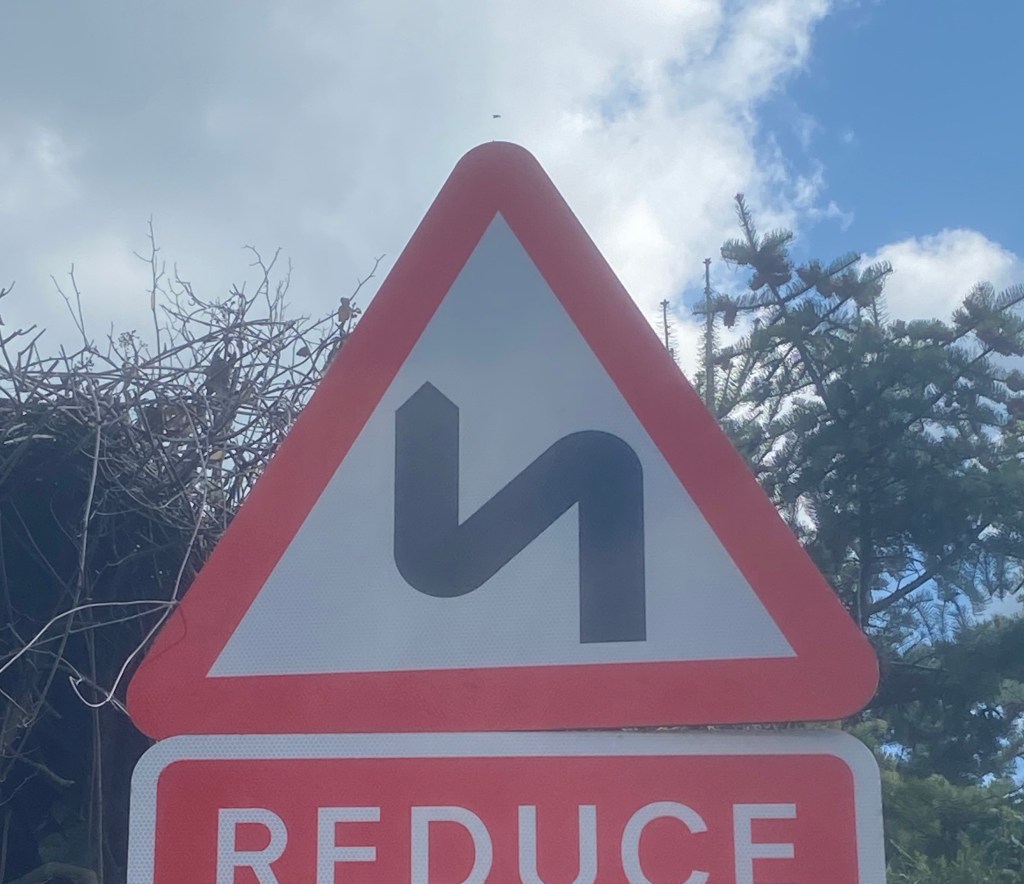
‘Definite resemblance,’ I reply.
 P. D. Clifton
Leave a comment